

Medium Duty Castors
Australian Wheel & Castors stocks medium duty castors for workshop trolleys, service carts, retail shelving, and light industrial equipment. Load ratings typically range from 150kg to 300kg per wheel, with wheel diameters from 75mm to 125mm. Swivel, fixed, and braked configurations are available in polyurethane, nylon, and rubber wheel materials. All orders ship fast across Australia.

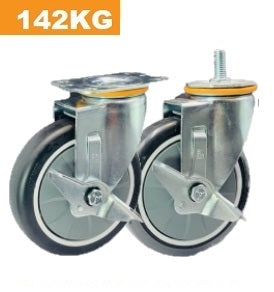

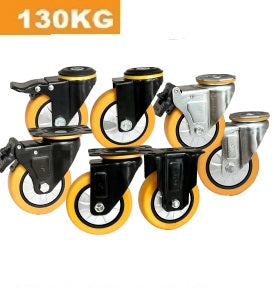

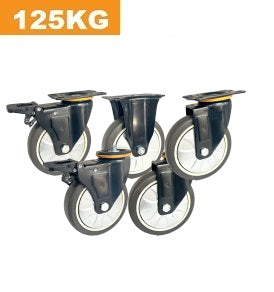


Medium Duty Castors: Specifications and Selection Guide
Medium duty castors bridge the gap between light domestic use and full industrial applications. They suit workshop trolleys, service carts, retail shelving units, and equipment that moves regularly under moderate loads. Selecting the right model requires matching the load rating, wheel material, and mounting type to the specific job.
Load Rating: 150kg to 300kg Per Wheel
Medium duty castors are rated from around 150kg to 300kg per wheel. For a four-castor trolley carrying 500kg, each castor needs to handle at least 125kg, with a safety buffer added for dynamic loading and uneven floors. Choosing a castor rated above the calculated minimum extends service life and reduces the risk of bracket fatigue.
Wheel Material and Floor Type
Polyurethane wheels are the most practical choice for most medium duty applications. They roll quietly on smooth concrete and vinyl, leave no marks, and handle the load range without excessive wear. Nylon wheels suit environments where chemical resistance matters, such as food processing areas or workshops with oil on the floor. Rubber wheels provide better grip on ramps and wet surfaces but wear faster under sustained heavy use.
Wheel Diameter and Rolling Resistance
Larger diameter wheels roll more easily over floor joins, cable covers, and thresholds. A 100mm wheel requires noticeably less push force than a 75mm wheel carrying the same load. For trolleys that travel long distances or are pushed by a single operator, selecting the largest diameter that fits the frame reduces fatigue.
Swivel, Fixed, and Braked Options
Swivel castors provide full directional control and suit trolleys that need to navigate around equipment and through doorways. Fixed castors track straight and add stability at the rear of a trolley. Braked models lock the wheel or the swivel to hold the trolley stationary during loading, unloading, or when parked on a slope.
Frequently Asked Questions
How do I know if I need medium duty or heavy duty castors?Calculate the load per castor by dividing the total weight by the number of wheels, then add a 25% buffer. If the result falls between 150kg and 300kg per castor, medium duty is the right category. Above 300kg per castor, move to heavy duty.
Are polyurethane castors suitable for outdoor use?Polyurethane wheels handle occasional outdoor use on smooth paving, but prolonged UV exposure degrades the material over time. For regular outdoor use, nylon or cast iron wheels are more durable.
What plate size do medium duty castors use?Plate dimensions vary by model, but most medium duty castors use a top plate in the range of 100mm x 80mm to 135mm x 110mm with four bolt holes. Check the product specification and measure your existing frame before ordering.
Can I mix swivel and fixed castors on the same trolley?Yes. A common configuration is two swivel castors at the front for steering and two fixed castors at the rear for straight-line stability. This reduces the effort needed to push a loaded trolley in a straight line.
How often should medium duty castors be replaced?Service life depends on load, floor condition, and frequency of use. Inspect castors every three to six months for wheel wear, bearing play, and bracket cracks. Replace any castor showing visible deformation or rough rolling before it fails under load.