

High & Low Temperature Castors
Australian Wheel & Castors stocks high and low temperature castors for environments where standard wheel materials fail. High temperature castors suit ovens, kilns, autoclaves, and heat treatment facilities operating up to 250°C or higher. Low temperature castors suit cold storage, freezer rooms, and cryogenic environments down to -40°C. Both ranges use wheel materials and bearing lubricants selected for the specific temperature conditions. All orders ship fast across Australia.



High and Low Temperature Castors: Selecting the Right Specification for Extreme Environments
Standard castors use wheel materials and bearing lubricants designed for ambient temperatures, typically between 0°C and 60°C. Outside this range, the wheel compound hardens, softens, or degrades, and the bearing grease loses viscosity or solidifies. High and low temperature castors use materials selected specifically for the operating environment, maintaining safe and reliable performance where standard castors would fail.
High Temperature Castors: Ovens, Kilns, and Heat Treatment
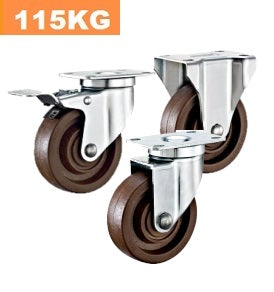
High temperature castors use cast iron, phenolic resin, or high-temperature nylon wheels that retain their structural integrity at elevated temperatures. Cast iron wheels handle continuous exposure above 200°C and suit oven trolleys, kiln cars, and autoclave carts. Phenolic resin wheels handle temperatures up to around 180°C and are quieter than cast iron on smooth surfaces. The bearing grease in high temperature castors is replaced with a high-temperature lubricant that does not break down or carbonise under heat.
Low Temperature Castors: Cold Storage and Freezer Rooms
Standard rubber and polyurethane wheels become brittle and crack at temperatures below -10°C. Low temperature castors use special rubber compounds or nylon wheels that remain flexible and functional down to -40°C. The bearing lubricant is a low-temperature grease that maintains viscosity in freezer conditions, preventing the bearing from seizing when the trolley is moved. Stainless steel or zinc-plated brackets resist the corrosion caused by condensation when equipment moves between cold and ambient environments.
Matching the Castor to the Temperature Range
Confirm the maximum and minimum operating temperatures before selecting a castor. For high temperature applications, check whether the castor will be exposed continuously or intermittently, as some materials handle short heat cycles better than sustained exposure. For cold storage, check whether the trolley will move between the freezer and ambient areas regularly, as repeated thermal cycling stresses both the wheel material and the bracket finish.
Frequently Asked Questions
What temperature can standard castors handle?Standard polyurethane and rubber castors are rated for ambient use, typically between 0°C and 60°C. Above 60°C, polyurethane softens and loses load capacity. Below 0°C, rubber becomes brittle. Outside these ranges, a temperature-rated castor is required.
What wheel material suits oven trolleys?Cast iron wheels are the standard choice for oven trolleys operating above 150°C. They handle continuous high heat without deforming. For temperatures between 80°C and 180°C, phenolic resin wheels are quieter and easier to push on smooth surfaces.
Can I use standard castors in a cool room at 2°C to 4°C?Yes. Standard castors handle cool room temperatures without issue. Low temperature castors are required for freezer rooms operating below -10°C, where standard rubber and polyurethane compounds begin to harden and crack.
Do low temperature castors need special maintenance?The bearing grease in low temperature castors is formulated for cold conditions and should not be replaced with standard grease. If the castor is regreased, use a low-temperature bearing grease rated for the operating temperature of your freezer room.
Can high temperature castors be used at room temperature?Yes. High temperature castors function normally at ambient temperatures. Cast iron wheels are harder and noisier than polyurethane on smooth floors, but there is no performance issue with using them outside a high-temperature environment.