

Level Adjustment Castors
Australian Wheel & Castors stocks level adjustment castors for machinery, equipment, and workstations that need to be both mobile and precisely levelled. These castors combine a swivel wheel for movement with a built-in levelling foot that can be lowered to lift the wheel off the floor and stabilise the equipment on an adjustable foot. Load ratings range from 200kg to 1,000kg per unit. All orders ship fast across Australia.

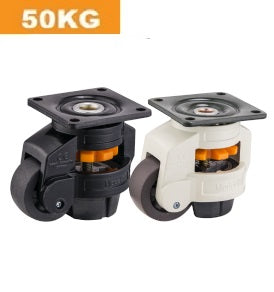


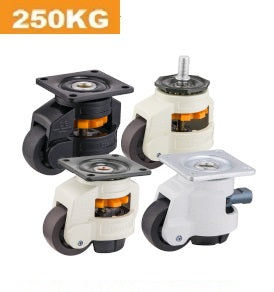

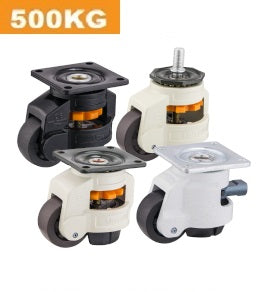

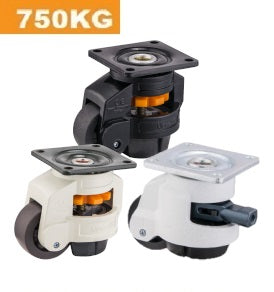

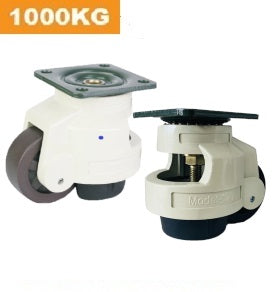

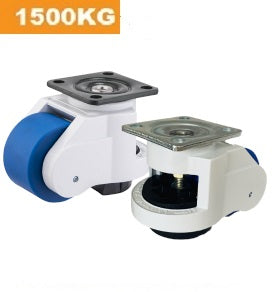
Level Adjustment Castors: Mobility and Precision Levelling in One Unit
Level adjustment castors solve a problem that standard castors and fixed levelling feet cannot solve individually: the need to move equipment freely and then lock it in a precisely levelled position without using separate components. A single unit combines a swivel castor for movement with a threaded levelling foot that lowers to lift the wheel off the floor and stabilise the equipment at the correct height and level.
How Level Adjustment Castors Work
The castor body mounts to the equipment leg or frame. When the levelling foot is retracted, the wheel contacts the floor and the equipment can be moved freely. When the levelling foot is extended by turning the adjustment screw or handle, it pushes down against the floor and lifts the wheel clear, transferring the load to the foot. Each foot can be adjusted independently to level the equipment precisely on uneven floors.
Typical Applications
Level adjustment castors are standard on CNC machines, lathes, milling machines, and other precision equipment that must be repositioned periodically but needs to be perfectly level during operation. They also suit laboratory benches, printing equipment, and any machinery where vibration from an unlevel base would affect output quality or measurement accuracy.
Load Rating and Foot Diameter
The load rating applies to the levelling foot, not the castor wheel. When the equipment is in use, the full weight rests on the feet. Confirm the foot load rating covers the total weight of the machine plus any tooling or workpiece. Larger foot diameters distribute the load over a wider area, which matters on softer floors or where floor loading limits apply.
Adjustment Range and Thread Pitch
The adjustment range determines how much height variation the foot can compensate for. Most models offer 20mm to 60mm of adjustment. Finer thread pitches allow more precise levelling but require more turns to achieve the same height change. For equipment requiring very precise levelling, such as coordinate measuring machines, select a model with a fine thread pitch and a locking nut to prevent the setting from shifting under vibration.
Frequently Asked Questions
Can level adjustment castors replace separate castors and levelling feet?Yes. A level adjustment castor performs both functions in a single unit. This simplifies installation, reduces the number of components, and eliminates the need to remove and refit separate levelling feet when repositioning equipment.
How much weight can the levelling foot support?Load ratings vary by model, from around 200kg to over 1,000kg per unit. For a four-unit installation on a 2,000kg machine, each unit needs to be rated for at least 500kg. Check the product specification for the foot load rating, not the castor wheel rating.
Do level adjustment castors work on uneven concrete floors?Yes. The independent adjustment of each foot allows the equipment to be levelled precisely even when the floor surface varies by 20mm to 60mm across the footprint of the machine, depending on the model's adjustment range.
Can the levelling foot shift during machine operation?On models with a locking nut, the foot position can be locked after levelling to prevent it from turning under vibration. For high-vibration applications, confirm the model includes a locking mechanism before ordering.
What floor types are suitable for level adjustment castors?Smooth concrete, epoxy-coated floors, and steel plate are all suitable. For softer floors such as timber or vinyl, confirm the foot base diameter provides adequate load distribution to avoid indentation under the full machine weight.